
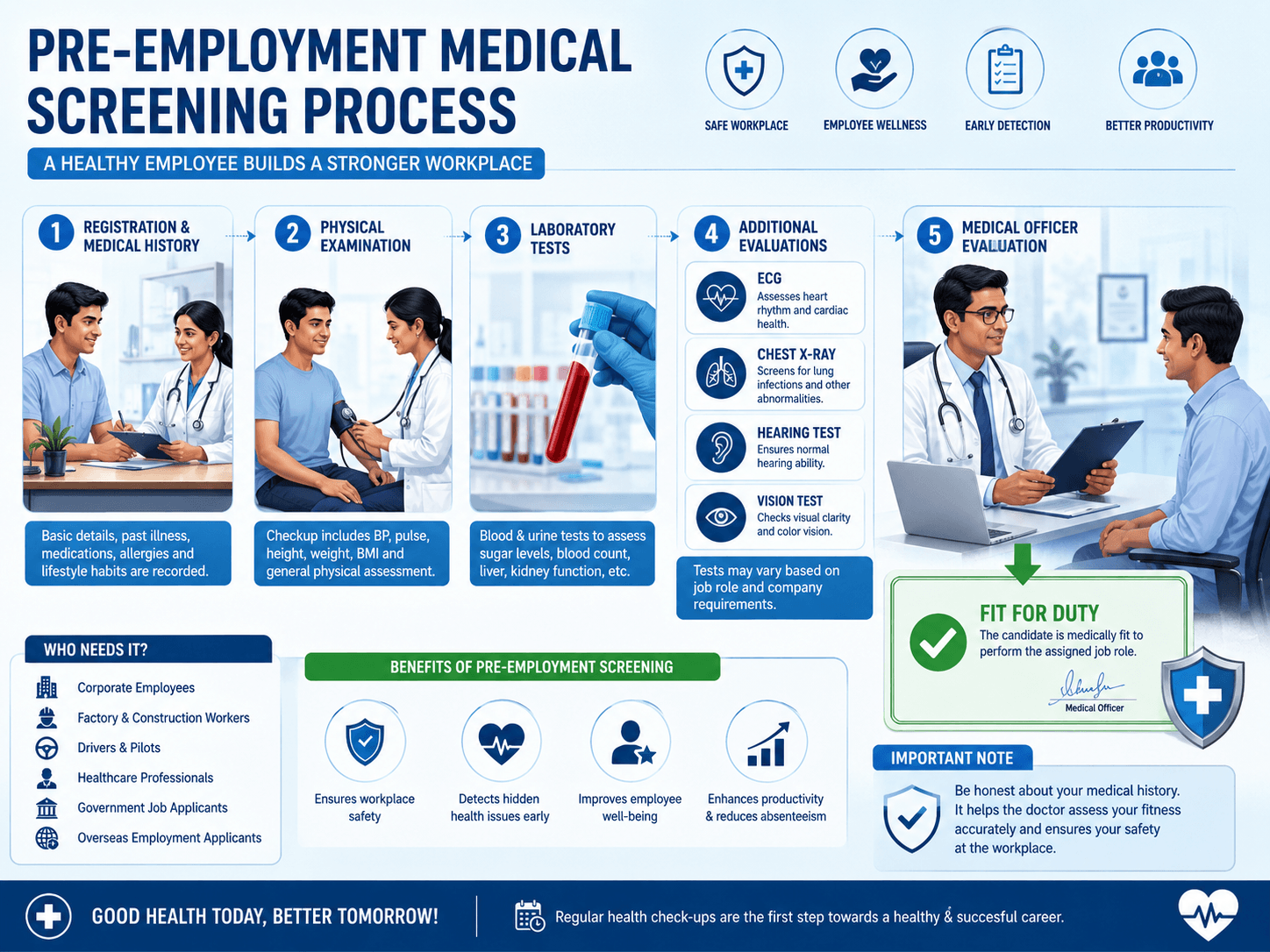
Starting a new job is an exciting step. However, before officially joining, many companies ask employees to undergo a Pre-Employment and Fitness Certificate evaluation. This process helps employers ensure that a candidate is medically fit to perform their job safely and effectively.
In clinical practice, many people become anxious when they hear about a “medical fitness test.” Fortunately, most pre-employment medical evaluations are routine and straightforward. They are designed not to reject healthy candidates unnecessarily, but rather to identify any health conditions that may need attention or workplace precautions.
Moreover, these evaluations help maintain workplace safety, especially in physically demanding roles, healthcare settings, corporate offices, factories, transportation services, and high-risk industries.
What Is a Pre-Employment and Fitness Certificate?
A Pre-Employment and Fitness Certificate is a medical document issued by a registered doctor after assessing a candidate’s physical and mental fitness for a particular job role.
The certificate usually confirms that:
- The candidate is medically fit for employment
- There are no major health risks affecting work performance
- The individual does not have contagious illnesses that may impact workplace safety
- Any chronic medical condition is stable and manageable
In addition, some companies may require specialised evaluations depending on the nature of the job.
Why Do Employers Ask for a Pre-Employment and Fitness Certificate?
Employers request medical fitness assessments for several important reasons.
Workplace Safety
First, companies want to ensure employees can safely perform job-related duties without risk to themselves or others.
Reduced Medical Emergencies
Secondly, identifying uncontrolled health conditions early may help reduce sudden medical emergencies at work.
Legal and Compliance Requirements
Certain industries legally require employee fitness evaluations. For example:
- Healthcare
- Aviation
- Construction
- Transportation
- Security services
- Food handling industries
Better Employee Wellbeing
Furthermore, pre-employment assessments may help employees identify hidden health issues early, such as:
- High blood pressure
- Diabetes
- Vision problems
- Obesity
- Respiratory illnesses
What Does a Pre-Employment Medical Examination Include?
The exact tests vary depending on the company and job profile. However, most Pre-Employment and Fitness Certificate evaluations commonly include the following.
Basic Medical History
The doctor may ask about:
- Past illnesses
- Surgeries
- Current medications
- Allergies
- Smoking or alcohol history
- Family history of major diseases
Many patients assume minor medical issues should be hidden. However, being honest helps doctors assess fitness accurately and safely.
Physical Examination
A routine physical examination generally includes:
- Blood pressure measurement
- Pulse rate
- Height and weight
- BMI assessment
- Temperature
- General physical assessment
Additionally, the doctor checks for signs of major medical problems.
Vision and Hearing Tests
Some jobs require proper sensory function. Therefore, companies may ask for:
- Eye vision testing
- Colour blindness testing
- Hearing evaluation
These are especially important for drivers, machine operators, pilots, and technical workers.
Blood Tests in Pre-Employment Screening
Many organisations include blood investigations as part of the Pre-Employment and Fitness Certificate process.
Common tests may include:
- Complete Blood Count (CBC)
- Blood Sugar Levels
- Liver Function Test
- Kidney Function Test
- Lipid Profile
- Blood Group
In some industries, infectious disease screening may also be required.
Urine Examination
Urine testing may help detect:
- Kidney disorders
- Diabetes
- Urinary infections
- Substance abuse in selected industries
Chest X-Ray and ECG
For certain jobs, additional tests may be advised.
Chest X-Ray
This may help detect:
- Tuberculosis
- Chronic lung disease
- Occupational lung conditions
ECG (Electrocardiogram)
An ECG evaluates heart rhythm and basic cardiac health.
This is commonly advised for:
- Individuals above 40 years
- High-stress jobs
- Physically demanding occupations
Mental Health and Psychological Assessment
Certain organisations may include mental wellness screening, particularly for:
- High-pressure jobs
- Security roles
- Aviation
- Corporate leadership positions
Importantly, these assessments are usually supportive rather than judgmental.
Who Needs a Pre-Employment and Fitness Certificate?
A Pre-Employment and Fitness Certificate may be required for:
- Corporate employees
- Government job applicants
- Healthcare workers
- Drivers and pilots
- Factory workers
- Hotel and hospitality staff
- IT professionals
- Overseas employment applicants
In addition, visa medical examinations often include fitness certification.
Can a Medical Condition Affect Employment?
This depends on:
- Severity of the condition
- Nature of the job
- Workplace safety concerns
- Functional limitations
For example, controlled diabetes or hypertension may not prevent employment in most office-based roles.
However, uncontrolled epilepsy may affect certain high-risk occupations such as commercial driving.
Fortunately, many chronic conditions can still be managed while continuing employment safely.
Common Reasons for Temporary Unfitness
Sometimes candidates may be declared temporarily unfit until treatment or recovery.
Examples include:
- Severe uncontrolled hypertension
- Active infections
- Uncontrolled diabetes
- Recent surgery recovery
- Acute respiratory infections
- Significant anaemia
In many cases, re-evaluation is possible after treatment.
How Should You Prepare for a Pre-Employment Medical Test?
To make the process smoother:
- Carry previous medical records if relevant
- Bring spectacles or hearing aids if used
- Sleep adequately before the examination
- Avoid alcohol before testing
- Stay hydrated
- Follow fasting instructions if blood tests require it
Additionally, avoid hiding important medical history.
Is the Fitness Certificate Confidential?
Yes, medical information is generally treated confidentially.
Usually, employers receive only the fitness status, such as:
- Fit
- Fit with recommendations
- Temporarily unfit
Detailed medical records are typically protected under medical confidentiality guidelines.
When Should You See a Doctor Before Employment Screening?
You should consider consulting a doctor beforehand if you already have:
- Diabetes
- High blood pressure
- Asthma
- Heart disease
- Thyroid disorders
- Previous surgeries
- Ongoing medications
This helps ensure proper documentation and smoother evaluation during the Pre-Employment and Fitness Certificate process.
Emergency Warning Signs That Should Not Be Ignored
Seek immediate medical attention if you experience:
- Chest pain
- Severe breathlessness
- Sudden fainting
- High fever
- Uncontrolled blood pressure
- Severe dizziness
- Persistent cough with blood
These symptoms require prompt medical evaluation before fitness certification.
FAQs
The validity depends on company policy. In many cases, it remains valid for 3–12 months.
Sometimes yes. Blood sugar and lipid profile testing may require fasting for 8–10 hours.
Controlled diabetes usually does not prevent employment. However, poorly controlled diabetes may require treatment before certification.
This depends on company policy and local legal guidelines. In many situations, routine pregnancy testing is not mandatory.
Most evaluations are completed within 1–3 hours, depending on the required investigations.
Mild or controlled hypertension may not be an issue. However, severely uncontrolled blood pressure may require temporary treatment before approval.
Final Takeaway
A Pre-Employment and Fitness Certificate is an important part of joining many organisations. Rather than being something to fear, it should be viewed as a valuable health assessment that protects both employees and employers.
In most cases, the process is simple, quick, and routine. Moreover, it may help identify silent health problems early so that proper treatment and lifestyle changes can begin on time.
If you have any existing medical condition, proper documentation and honest communication with the examining doctor can make the evaluation smoother and safer.